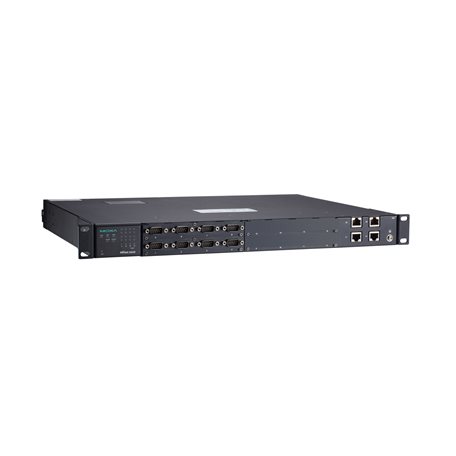
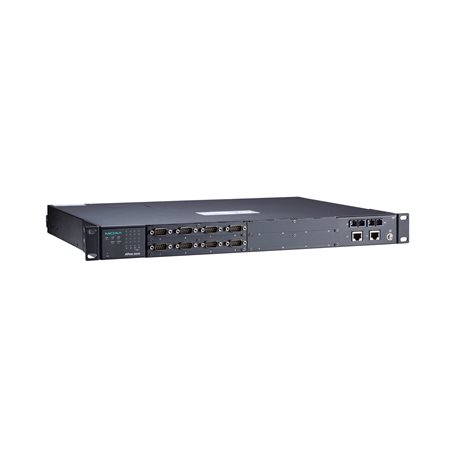
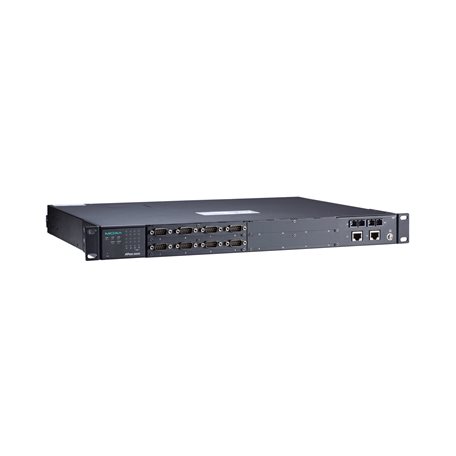
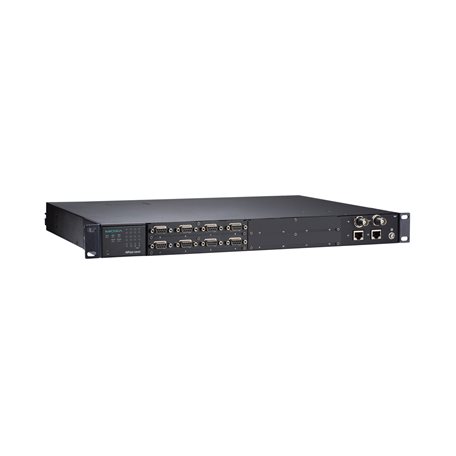
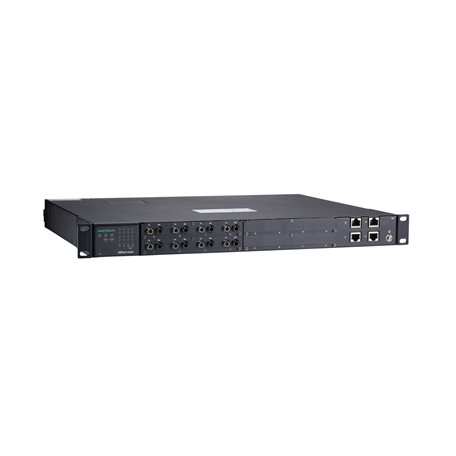
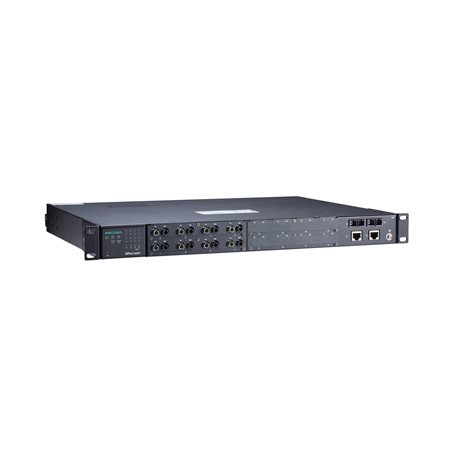
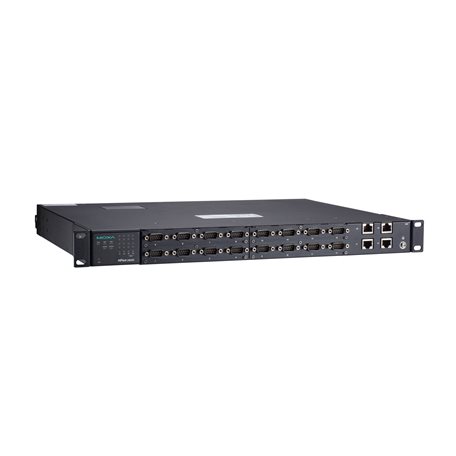
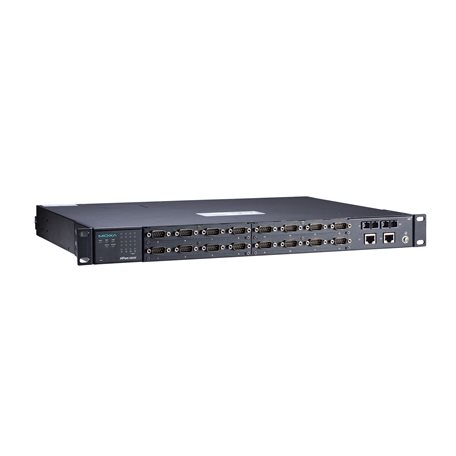
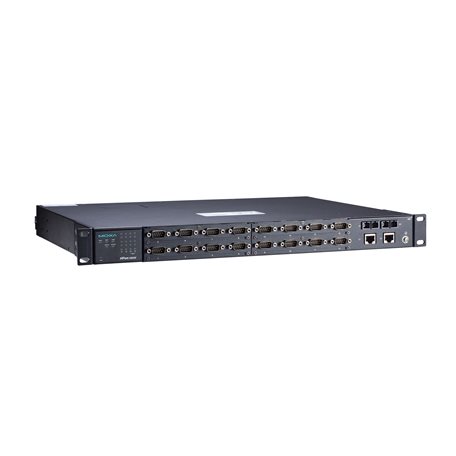
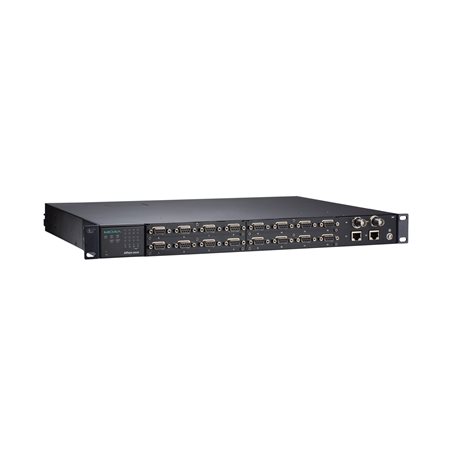
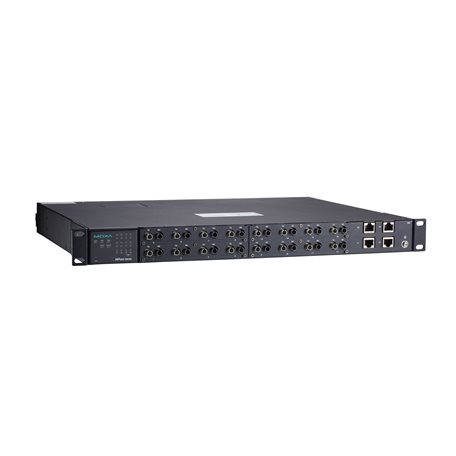
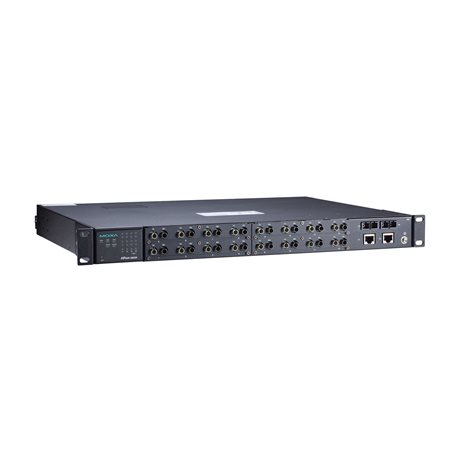
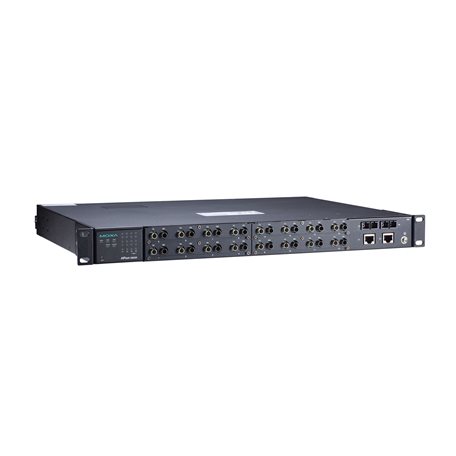
The NPort S9650I Series 8/16-port RS-232/422/485
device servers, which come with a built-in full-function managed Ethernet
switch, are designed specifically for the harsh environmental conditions
found in electrical substations. With both fiber and wired Ethernet
ports supported, the combination of a device server and Ethernet switch
gives users the ability to easily install, manage, and maintain the
NPort S9650I itself, as well as attached serial devices.
Electromagnetic
Compatibility for Harsh Substation Environments
The NPort S9650I Series supports a high level of surge protection
to prevent damage from the types of power surges and EMI one finds
in electrical substations and industrial automation applications.
Combined with a -40 to 85°C operating temperature range and galvanized
steel housing, the NPort S9650I is suitable for a wide range of industrial
environments.
Another plus is the NPort
S9650I’s dual power supplies, which provide both redundancy, as well
as a wide range of voltage inputs. The WV models accept a 24/48 VDC
power input (ranging from 18 to 72 VDC), and the HV models accept
a power input of 88 to 300 VDC and 85 to 264 VAC.
Power SCADA With IEC 61850 MMS for Easy Maintenance
The current trend in power SCADA applications
is to control and monitor both IT devices (switches, routers, etc.)
and IEDs (sensors, actuators, etc.) with the MMS protocol. Contrast
this with the more traditional management approach of using SNMP for
IT devices and MMS for IEDs. In fact, SIs may even need to manage
a variety of legacy devices that use proprietary communications protocols.
The NPort S9650I device
servers are the world’s first device servers to integrate MMS into
an IT-type device designed specifically for power SCADA applications.
The NPort S9650I even supports using MMS to monitor serial communications
between the S9650I and legacy devices.
Supports Modbus/DNP3 Protocol Gateway
The NPort S9650I Series provides maximum flexibility
for integrating industrial Modbus/DNP3 networks of all types and sizes.
The NPort S9650I is designed to integrate Modbus TCP, ASCII, and RTU
devices in almost any master/slave combination, including simultaneous
serial and Ethernet masters.
The NPort S9650I device servers also support
protocol conversion between DNP3 serial and DNP3 IP, and all models
are ruggedly constructed to ensure reliable operation.
Cybersecurity Features Based on IEC 62443/NERC CIP
The NPort S9650I Series has security features
based on IEC 62443/NERC CIP to provide a high level of cybersecurity.
Protecting mission-critical networks from cyberattacks is a high priority
for industrial automation applications, which can suffer large losses
due to extended network downtime.
Supports IEEE
1588v2 and IRIG-B Time Synchronization Functions
The NPort S9650I Series, which has a modular design that supports
IEEE 1588v2 and IRIG-B time synchronization, is able to interconnect
and synchronize multiple types of intelligent electronic devices (IEDs)
that use different communication protocols. The time source is provided
via IEEE 1588v2 and converted to IRIG-B for distribution to the IEDs
via the serial ports or via a dedicated IRIG-B BNC connector.
Ring Redundancy at the Device Level
Device-level communication networks for industrial
automation are very critical since they are used to control and monitor
device processes. The reliability of these communications depends
on ring redundancy at the device level, which is designed to provide
fast network fault detection and reconfiguration to support the most
demanding control applications. The NPort S9650I Series integrates a
full-function NPort device server with an industrial switch to carry
serial and Ethernet devices at the same time. In addition, the NPort
S9650I Series can achieve ring redundancy with standard STP/RSTP and
Moxa’s proprietary Turbo Ring or Turbo Chain 2 redundancy protocols.
This all-in-one design can be used to optimize and simplify your device
network and enhance reliability.
Note: When connecting a single-mode fiber transceiver, we recommend using an attenuator to prevent damage caused by excessive optical power. Note: Compute the “typical distance” of a specific fiber transceiver as follows: Link budget (dB) > dispersion penalty (dB) + total link loss (dB).
Standards
IEEE 802.1D-2004 for Spanning Tree Protocol IEEE 802.1p for Class of Service IEEE 802.1Q for VLAN Tagging IEEE 802.1w for Rapid Spanning Tree Protocol IEEE 802.1X for authentication IEEE 802.3 for 10BaseT IEEE 802.3ad for Port Trunk with LACP IEEE 802.3u for 100BaseT(X) and 100BaseFX
IGMP Groups
256
Max. No. of VLANs
64
Priority Queues
4
VLAN ID Range
VID 1 to 4094
Configuration Options
Web Console (HTTP/HTTPS), Windows Utility, Device Search Utility (DSU), MCC Tool, Command Line Interface (CLI) through Serial/Telnet/SSH
Windows 95/98/ME/NT/2000, Windows XP/2003/Vista/2008/7/8/8.1/10 (x86/x64), Windows 2008 R2/2012/2012 R2/2016/2019 (x64), Windows Embedded CE 5.0/6.0, Windows XP Embedded
Linux Real TTY Drivers
Kernel versions: 2.4.x, 2.6.x, 3.x, 4.x, and 5.x
Fixed TTY Drivers
SCO UNIX, SCO OpenServer, UnixWare 7, QNX 4.25, QNX 6, Solaris 10, FreeBSD, AIX 5.x, HP-UX 11i, Mac OS X





.jpg)